Archipelagos

  • English
  • Ελληνικα
Who We Are
The TeamThe Team
Research BasesResearch Bases
Research BoatsResearch Boats
Our EquipmentOur Equipment
PartnersPartners
SupportersSupporters
Fields of Action
Marine ConservationMarine Conservation Fisheries Shipping Risks Seagrass Meadows Coralligene Conservation Littoral Ecosystems Invasive Species Jellyfish Sea Turtles
Marine MammalsMarine Mammals Dolphins and Porpoises Whales Seals
Terrestrial ConservationTerrestrial Conservation Island Fauna Forests & Flora Freshwater Ecosystems Aegean Seed Bank
Laboratory ResearchLaboratory Research Microplastics Water Analysis Soil Quality
Projects
Aegean Marine Life Sanctuary
Eco-Navigation
FIsh4Life
Save the Aegean
Join Us
Internships in the Aegean
Remote Internships
Interns Experiences
Field Courses
News
Planting Underwater Gardens of Posidonia seagrass- a new innovative planting process
Aegean Islet Conservation Project in cooperation with the University of Toronto’s Faculty of Architecture
Mutilated Striped Dolphin Stranded on the shores of Samos Island
Posidonia Seagrass Fruits Wash up on Our Shores – A Rare Phenomenon
View All...
Contact us
Publications
Videos
Awareness Material
Donate
Menu

Another Deliberate Killing of a Monk Seal

Another Deliberate Killing of a Monk Seal

by Archipelagos / Wednesday, 05 November 2014 / Published in Marine Mammals, Press Releases

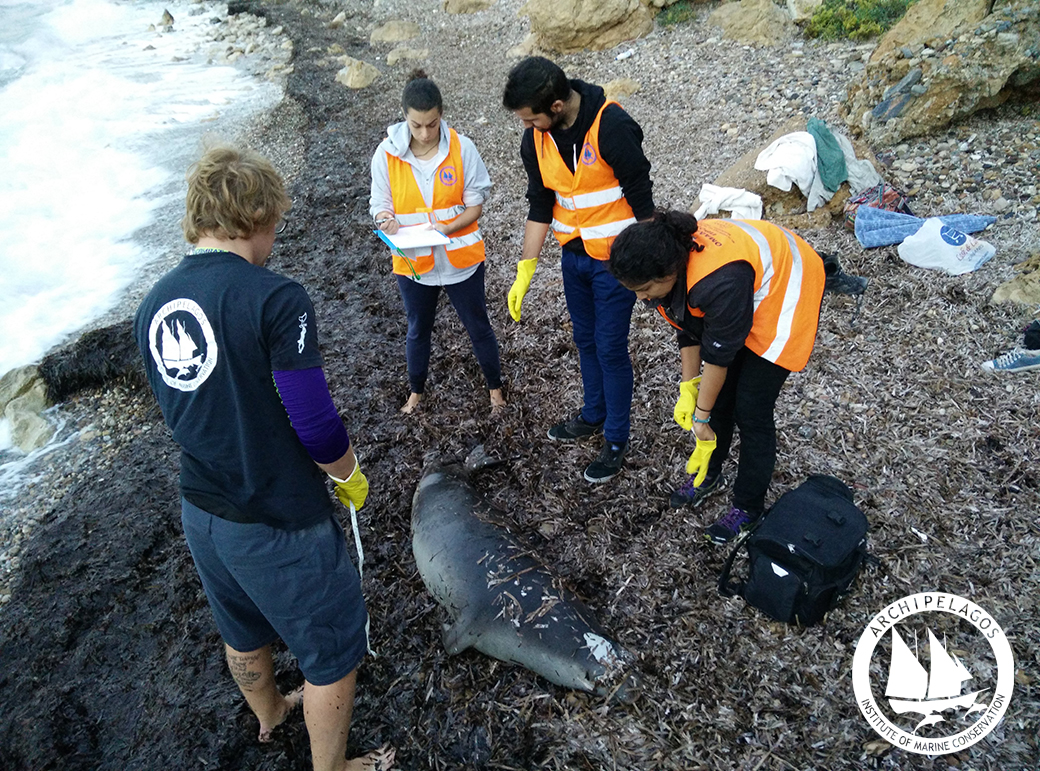
A new case of a monk seal being killed deliberately was discovered last weekend in Samos island. This intensifies our concern about the increase in the rate of the Mediterranean Monk Seal population decline – the most endangered species of marine mammal in Europe.

After being informed by local residents, the Archipelagos research team spotted the unfortunate animal floating dead in the sea to the North West of Samos. The seal was a juvenile male of approximately 1.5m in length and did not exhibit any external wounds. The autopsy conducted by Archipelagos’ marine biologists found no pathogenic cause of death while it also established that the seal had fed normally just a few hours before its death.

These facts, combined with the extensive internal bleeding and other findings, have led to the conclusion that the death was caused by a shock wave of exploding dynamite used for illegal fishing.

Archipelagos is preparing a lawsuit against the currently unknown perpetrator of this crime, while is also contributing in the investigation that is trying to identify the person responsible for the killing of this seal.

Despite being signatories of international conventions as well as national legislation, by which Greece is bound to protect the Mediterranean Monk Seals, protection measures are left wanting and little effective action is taken. In recent years millions of untargeted funds have been spend in urban centers in order to protect the species – this has not been an effective nor efficient solution to the problem:

There is the “war of survival” between the fishermen and marine mammals, which are competing for the few fish left. This results in increased interaction between them, with increasingly frequent damage to fishing gear caused by seals and dolphins, while the mammals “stealing” fish from the fishermen to survive.

So even though effective measures should have already been taken to give an end to this inevitable competition, instead fishermen are left helpless to cover by themselves the true cost of conservation of this highly endangered species in Greece.

However it should be noted that despite the cost implications of the losses for coastal fishermen, the Greek seas is where the largest remaining population of Mediterranean monk seal survives worldwide. Therefore, deliberate killing of monk seals such as this recent incident, is perpetrated by a minority of fishermen and such actions should not and do not characterize Greek fishermen as an industry. Most fishermen coexist with marine mammals, expecting that eventually the national and EU authorities, as well as the civil society, will take responsibility to protect both marine mammals and fishermen.

This recent incident could be a reason for the fishermen to isolate and vilify anyone who takes illegal actions and contributes to the extinction of rare species from the Greek seas.

For anyone that has mistaken this seal for the seal that the fishermen have named “Argyro”: Please know that Argyro is safe and sound thanks to the efforts of Archipelagos’ members and hard working volunteers from the local community, who are monitoring and protecting her for the past 7 months.


Anastasia Miliou
Research Director, Archipelagos Institute of Marine Conservation
0
0
0
0
0

What you can read next

Two rare large squid recorded in the Eastern Aegean
Stranding of three striped dolphins in the NE Aegean
The new boat of Archipelagos Institute

HIGHLIGHTS

  • International Visitors at the Aegean Marine Life Sanctuary Project

    International Visitors at the Aegean Marine Life Sanctuary Project

    1 June 2021
    At Archipelagos Institute of Marine Conservation an important visit took …
  • The Efkranti Award was Granted to the Archipelagos Institute of Marine Conservation
    The Efkranti Award was Granted to the Archipelagos Institute of Marine Conservation

    27 July 2020
    It was a great honor but also great moral support …
  • The President of the Hellenic Republic’s visit to Archipelagos research vessel, the Aegean Explorer

    The President of the Hellenic Republic’s visit to Archipelagos research vessel, the Aegean Explorer

    30 June 2020
    Yesterday, during the President of the Republic’s visit to the …
  • Award to Archipelagos: Best Heroic Act of Environmental Stewardship

    Award to Archipelagos: Best Heroic Act of Environmental Stewardship

    19 February 2020
    The Short Documentary Film presenting the Aegean Marine Life Sanctuary, …
  • Award to Archipelagos Institute from the International Propeller Club of the United States

    Award to Archipelagos Institute from the International Propeller Club of the United States

    6 February 2020
    We would like to thank the International Propeller Club of …

Recent Posts

  • Photo-ID & Behavioral Assessments of Delphinus delphis in the Northern Aegean Sea

    Photo-ID & Behavioral Assessments of Delphinus delphis in the Northern Aegean Sea

    2 November 2023
    Yasas! Intern Alannah from the Marine Mammal Field here, currently …
  • Experiences After Work at Archipelagos

    Experiences After Work at Archipelagos

    2 November 2023
    Hi, I’m Ella and I completed a 6-week internship on …
  • Hands-on Projects with the Marine Mammal Research & Conservation Team

    Hands-on Projects with the Marine Mammal Research & Conservation Team

    2 November 2023
    My name is Sjoerd and I am in the last …
  • Planting Underwater Gardens of Posidonia seagrass- a new innovative planting process

    Planting Underwater Gardens of Posidonia seagrass- a new innovative planting process

    29 June 2023
    An innovative process of planting underwater gardens of Posidonia oceanica …
  • A special three-day research expedition to the Ikaria Trench

    A special three-day research expedition to the Ikaria Trench

    19 May 2023
    Archipelagos Marine Mammal Research team took part in a very …
  • Aegean Islet Conservation Project in cooperation with the University of Toronto’s Faculty of Architecture

    Aegean Islet Conservation Project in cooperation with the University of Toronto’s Faculty of Architecture

    17 May 2023
    A new cycle of interdisciplinary on-site research of the Aegean …
  • Mutilated Striped Dolphin Stranded on the shores of Samos Island

    Mutilated Striped Dolphin Stranded on the shores of Samos Island

    12 May 2023
    A mutilated striped dolphin was found stranded on the north …

Subscribe to Our Newsletter

Archipelagos Institute of Marine Conservation is committed to researching and defending the biodiversity of the Greek seas and islands.

Our action is possible only with your help!

donate
  • Contact us
  • Placements

Archipelagos - Institute of Marine Conservation © All Rights Reserved || Developed Fekas Brothers

TOP