
Archipelagos

  • English
  • Ελληνικα
Who We Are
The TeamThe Team
Research BasesResearch Bases
Research BoatsResearch Boats
Our EquipmentOur Equipment
PartnersPartners
SupportersSupporters
Fields of Action
Marine ConservationMarine Conservation Fisheries Shipping Risks Seagrass Meadows Coralligene Conservation Littoral Ecosystems Invasive Species Jellyfish Sea Turtles
Marine MammalsMarine Mammals Dolphins and Porpoises Whales Seals
Terrestrial ConservationTerrestrial Conservation Island Fauna Forests & Flora Freshwater Ecosystems Aegean Seed Bank
Laboratory ResearchLaboratory Research Microplastics Water Analysis Soil Quality
Projects
Aegean Marine Life Sanctuary
Eco-Navigation
FIsh4Life
Save the Aegean
Join Us
Internships in the Aegean
Remote Internships
Interns Experiences
Field Courses
News
Planting Underwater Gardens of Posidonia seagrass- a new innovative planting process
Aegean Islet Conservation Project in cooperation with the University of Toronto’s Faculty of Architecture
Mutilated Striped Dolphin Stranded on the shores of Samos Island
Posidonia Seagrass Fruits Wash up on Our Shores – A Rare Phenomenon
View All...
Contact us
Publications
Videos
Awareness Material
Donate
Menu

Determining the Ratio of Microplastic in Zooplankton in Surface Waters Surrounding Samos Island

Determining the Ratio of Microplastic in Zooplankton in Surface Waters Surrounding Samos Island

by Kleopatra Delaveri / Thursday, 21 December 2017 / Published in Intern Experience, Marine Conservation Team, Microplastic Team, Work Journal

The presence of vast amounts of plastics in our oceans is cause for great concern for our marine wildlife due to their toxicity, persistence and ubiquity. With the production of plastics increasing, these pollutants are entering our oceans and breaking down into microplastics (MPs) at an ever-increasing rate. Microplastics are buoyant fragments of <5mm which can easily and readily enter the food chain by ingestion and bioaccumulation. This is potentially detrimental to the health of the organisms involved as plastics contain harmful chemical additives such as bisphenols and phthalates which are known to be released from the polymer over time.

Due to our limited knowledge of the effects and distribution of MPs it is important for scientists to continue research on MPs to further understand the extent of the problem and to ensure appropriate policy changes happen in regards to the reduction of plastic use; particularly in disposable products, regulating the use of additives and recycling plastic products more effectively. For this reason, we have developed a project to identify the amount of microplastic in the surface water in relation to an important food source, namely zooplankton.

Zooplankton are small organisms which drift in the surface water weakly swimming but primarily moved with currents. They make up part of the planktonic food chain along with phytoplankton. The planktonic food chain is the primary food source for a wide range of aquatic animals including fish and whales. As zooplankton are a key base component of many food webs the potential for the MP contained in zooplankton and the MP that are consumed because they are mistaken for zooplankton have a higher potential for bioaccumulation.

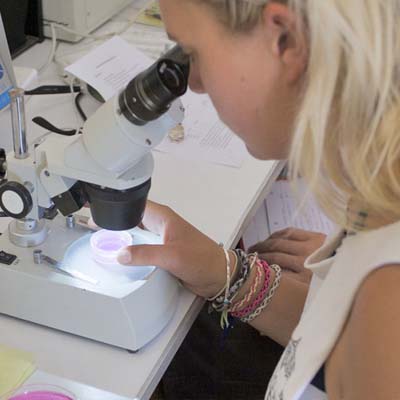
We are currently taking surface water samples, using a plankton net, both inshore and offshore. The samples are then fixed in 4% buffered formaldehyde to preserve zooplankton and left to separate in saturated saline solution. Once separated, the top fraction will be taken and filtered onto a 1.27 micrometre Whatman filter paper and viewed under a microscope to quantify microplastic fragments. The bottom fraction containing the denser biomass will be analysed for zooplankton and these will be counted using a Bogorov counting chamber. With these results, we can calculate the ratio of zooplankton to microplastic present.
Iskra Nicetic, BSc Biotechnology, University of New South Wales, Australia



0
0
0
0
0

What you can read next

Scouts Visit at Archipelagos Institute
Behavioral Study of Cetaceans in the Aegean
Microplastics Research at Archipelagos

HIGHLIGHTS

  • International Visitors at the Aegean Marine Life Sanctuary Project

    International Visitors at the Aegean Marine Life Sanctuary Project

    1 June 2021
    At Archipelagos Institute of Marine Conservation an important visit took …
  • The Efkranti Award was Granted to the Archipelagos Institute of Marine Conservation

    The Efkranti Award was Granted to the Archipelagos Institute of Marine Conservation

    27 July 2020
    It was a great honor but also great moral support …
  • The President of the Hellenic Republic’s visit to Archipelagos research vessel, the Aegean Explorer

    The President of the Hellenic Republic’s visit to Archipelagos research vessel, the Aegean Explorer

    30 June 2020
    Yesterday, during the President of the Republic’s visit to the …
  • Award to Archipelagos: Best Heroic Act of Environmental Stewardship

    Award to Archipelagos: Best Heroic Act of Environmental Stewardship

    19 February 2020
    The Short Documentary Film presenting the Aegean Marine Life Sanctuary, …
  • Award to Archipelagos Institute from the International Propeller Club of the United States

    Award to Archipelagos Institute from the International Propeller Club of the United States

    6 February 2020
    We would like to thank the International Propeller Club of …

Recent Posts

  • Photo-ID & Behavioral Assessments of Delphinus delphis in the Northern Aegean Sea

    Photo-ID & Behavioral Assessments of Delphinus delphis in the Northern Aegean Sea

    2 November 2023
    Yasas! Intern Alannah from the Marine Mammal Field here, currently …
  • Experiences After Work at Archipelagos

    Experiences After Work at Archipelagos

    2 November 2023
    Hi, I’m Ella and I completed a 6-week internship on …
  • Hands-on Projects with the Marine Mammal Research & Conservation Team

    Hands-on Projects with the Marine Mammal Research & Conservation Team

    2 November 2023
    My name is Sjoerd and I am in the last …
  • Planting Underwater Gardens of Posidonia seagrass- a new innovative planting process

    Planting Underwater Gardens of Posidonia seagrass- a new innovative planting process

    29 June 2023
    An innovative process of planting underwater gardens of Posidonia oceanica …
  • A special three-day research expedition to the Ikaria Trench

    A special three-day research expedition to the Ikaria Trench

    19 May 2023
    Archipelagos Marine Mammal Research team took part in a very …
  • Aegean Islet Conservation Project in cooperation with the University of Toronto’s Faculty of Architecture

    Aegean Islet Conservation Project in cooperation with the University of Toronto’s Faculty of Architecture

    17 May 2023
    A new cycle of interdisciplinary on-site research of the Aegean …
  • Mutilated Striped Dolphin Stranded on the shores of Samos Island

    Mutilated Striped Dolphin Stranded on the shores of Samos Island

    12 May 2023
    A mutilated striped dolphin was found stranded on the north …

Subscribe to Our Newsletter

Archipelagos Institute of Marine Conservation is committed to researching and defending the biodiversity of the Greek seas and islands.

Our action is possible only with your help!

donate
  • Contact us
  • Placements

Archipelagos - Institute of Marine Conservation © All Rights Reserved || Developed Fekas Brothers

TOP