
Archipelagos

  • English
  • Ελληνικα
Who We Are
The TeamThe Team
Research BasesResearch Bases
Research BoatsResearch Boats
Our EquipmentOur Equipment
PartnersPartners
SupportersSupporters
Fields of Action
Marine ConservationMarine Conservation Fisheries Shipping Risks Seagrass Meadows Coralligene Conservation Littoral Ecosystems Invasive Species Jellyfish Sea Turtles
Marine MammalsMarine Mammals Dolphins and Porpoises Whales Seals
Terrestrial ConservationTerrestrial Conservation Island Fauna Forests & Flora Freshwater Ecosystems Aegean Seed Bank
Laboratory ResearchLaboratory Research Microplastics Water Analysis Soil Quality
Projects
Aegean Marine Life Sanctuary
Eco-Navigation
FIsh4Life
Save the Aegean
Join Us
Internships in the Aegean
Remote Internships
Interns Experiences
Field Courses
News
Planting Underwater Gardens of Posidonia seagrass- a new innovative planting process
Aegean Islet Conservation Project in cooperation with the University of Toronto’s Faculty of Architecture
Mutilated Striped Dolphin Stranded on the shores of Samos Island
Posidonia Seagrass Fruits Wash up on Our Shores – A Rare Phenomenon
View All...
Contact us
Publications
Videos
Awareness Material
Donate
Menu

Research Expeditions over the Ikaria Trench 

Research Expeditions over the Ikaria Trench 

by Ambrosine Clark / Friday, 20 August 2021 / Published in Intern Experience, Marine Mammal Team, Work Journal

During the research expeditions over the Ikaria Trench, the Archipelagos’ marine mammal team aim to gather data on the species living over this important hotspot, to increase our knowledge on their behaviour, distribution and density. Weather-allowing, boat surveys extend to  further areas during multiple-day research expeditions. 
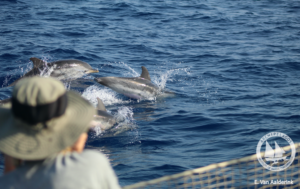
During the multiple day surveys up to the Ikaria trench, our research team aims to collect data on all species that can be found in this hotspot, such as the striped dolphins (Stenella coeruleoalba) seen above.

The surveys usually occur between the islands of Ikaria, Fourni and Samos. This area is characterized by a deep-water trench that exceeds 1000 meters in depth and hosts a rare diversity of marine life. The Ikaria trench is one of the most important migratory routes and feeding areas for large marine mammals in the North-East Mediterranean, such as sperm whales (Physeter macrocephalus), Cuvier’s beaked whales (Ziphius cavirostris) and Risso’s dolphins (Grampus griseus). 
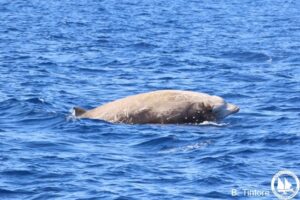
Cuvier’s beaked whale (Ziphius cavirostris) are one of the most elusive marine mammal found in the area. The data is deficient for this species, which can be partially explained by beaked whales’ ability to dive to incredible depths (one individual was recorded to dive 3 hours and 42 minutes, to a depth of almost 3 kilometres)


Cuvier’s beaked whales and sperm whales are deep-diving species that can descend to more than 1000 meters and stay underwater for over an hour. Little information is available on their distribution in the Mediterranean, due to their short surface period and long dive time, making it difficult to observe them at open sea. Archipelagos’ Marine Mammal research team surveys the trench as many times as possible in the year in order to gather information on these understudied species. In the past six weeks, we have already been able to collect data on Cuvier’s beaked whales on three separate occasions. Photographic and behavioural data has also been collected on the Risso’s dolphin (Grampus griseus). This  migratory species, found within small groups, feed on cephalopods such as squid. Risso’s dolphins are easy to identify due to their white scars, which increase with age.
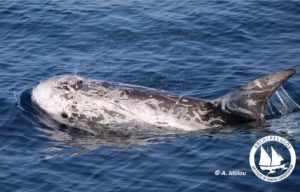
Risso’s dolphins (Grampus griseus) are other inhabitants of the Ikaria trench that have been observed by the Archipelagos research team. Their white scaring makes them easily identifiable for photo identification.


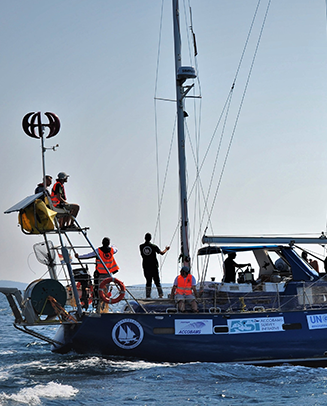
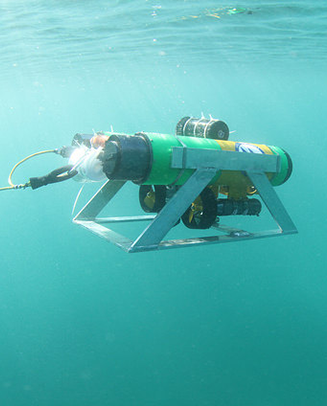
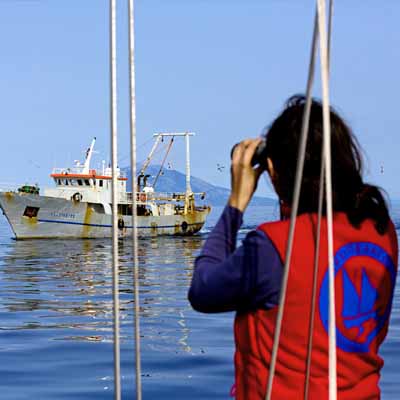
During the boat surveys, the marine mammal team records several types of data. Interns continuously collect data regarding environmental conditions, marine litter count, bioacoustics, microplastics and seabirds. When a sighting occurs, the team records photographic data with DSLR cameras, acoustic data with a hydrophone and behavioural data through datasheet notations and with a video-camera. 
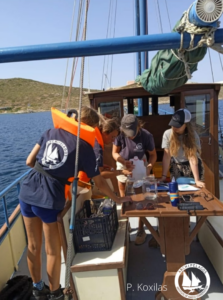
Microplastics data being recorded by the marine mammal research team on one of our research vessels.


These boat surveys are an important step in Archipelagos’ mission to fill the knowledge gaps concerning marine mammals in the Aegean Sea. The data we collect is being analysed to discover more about whales and dolphins’ behaviour, population sizes, migratory routes, anthropogenic threats, and many other factors. Our research has helped advise conservation methods for Mediterranean marine life for over 21 years, and continues to do so with our ever-expanding databases.  
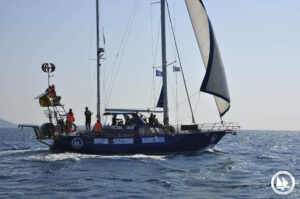
Naftilos is one of Archipelagos Institute’s research vessels


By 

Nikola Semerakova, MSc. Marine Biology at Czech University of Life Sciences, Czech Republic; 

Maëva Lebrun, BSc. student at INP – Ensat (École Nationale Supérieure Agronomique de Toulouse), France
0
0
0
0
0

What you can read next

Applying Varied Skills – creative and scientific – to an Internship with Archipelagos
Invasive Algae Caulerpa cylindracea: Factors and Consequences of the Distribution in Aegean Sea
Assessment of the butterfly biodiversity in Lipsi during spring

HIGHLIGHTS

  • International Visitors at the Aegean Marine Life Sanctuary Project

    International Visitors at the Aegean Marine Life Sanctuary Project

    1 June 2021
    At Archipelagos Institute of Marine Conservation an important visit took …
  • The Efkranti Award was Granted to the Archipelagos Institute of Marine Conservation

    The Efkranti Award was Granted to the Archipelagos Institute of Marine Conservation

    27 July 2020
    It was a great honor but also great moral support …
  • The President of the Hellenic Republic’s visit to Archipelagos research vessel, the Aegean Explorer

    The President of the Hellenic Republic’s visit to Archipelagos research vessel, the Aegean Explorer

    30 June 2020
    Yesterday, during the President of the Republic’s visit to the …
  • Award to Archipelagos: Best Heroic Act of Environmental Stewardship

    Award to Archipelagos: Best Heroic Act of Environmental Stewardship

    19 February 2020
    The Short Documentary Film presenting the Aegean Marine Life Sanctuary, …
  • Award to Archipelagos Institute from the International Propeller Club of the United States

    Award to Archipelagos Institute from the International Propeller Club of the United States

    6 February 2020
    We would like to thank the International Propeller Club of …

Recent Posts

  • Photo-ID & Behavioral Assessments of Delphinus delphis in the Northern Aegean Sea

    Photo-ID & Behavioral Assessments of Delphinus delphis in the Northern Aegean Sea

    2 November 2023
    Yasas! Intern Alannah from the Marine Mammal Field here, currently …
  • Experiences After Work at Archipelagos

    Experiences After Work at Archipelagos

    2 November 2023
    Hi, I’m Ella and I completed a 6-week internship on …
  • Hands-on Projects with the Marine Mammal Research & Conservation Team

    Hands-on Projects with the Marine Mammal Research & Conservation Team

    2 November 2023
    My name is Sjoerd and I am in the last …
  • Planting Underwater Gardens of Posidonia seagrass- a new innovative planting process

    Planting Underwater Gardens of Posidonia seagrass- a new innovative planting process

    29 June 2023
    An innovative process of planting underwater gardens of Posidonia oceanica …
  • A special three-day research expedition to the Ikaria Trench

    A special three-day research expedition to the Ikaria Trench

    19 May 2023
    Archipelagos Marine Mammal Research team took part in a very …
  • Aegean Islet Conservation Project in cooperation with the University of Toronto’s Faculty of Architecture

    Aegean Islet Conservation Project in cooperation with the University of Toronto’s Faculty of Architecture

    17 May 2023
    A new cycle of interdisciplinary on-site research of the Aegean …
  • Mutilated Striped Dolphin Stranded on the shores of Samos Island

    Mutilated Striped Dolphin Stranded on the shores of Samos Island

    12 May 2023
    A mutilated striped dolphin was found stranded on the north …

Subscribe to Our Newsletter

Archipelagos Institute of Marine Conservation is committed to researching and defending the biodiversity of the Greek seas and islands.

Our action is possible only with your help!

donate
  • Contact us
  • Placements

Archipelagos - Institute of Marine Conservation © All Rights Reserved || Developed Fekas Brothers

TOP