
Archipelagos

  • English
  • Ελληνικα
Who We Are
The TeamThe Team
Research BasesResearch Bases
Research BoatsResearch Boats
Our EquipmentOur Equipment
PartnersPartners
SupportersSupporters
Fields of Action
Marine ConservationMarine Conservation Fisheries Shipping Risks Seagrass Meadows Coralligene Conservation Littoral Ecosystems Invasive Species Jellyfish Sea Turtles
Marine MammalsMarine Mammals Dolphins and Porpoises Whales Seals
Terrestrial ConservationTerrestrial Conservation Island Fauna Forests & Flora Freshwater Ecosystems Aegean Seed Bank
Laboratory ResearchLaboratory Research Microplastics Water Analysis Soil Quality
Projects
Aegean Marine Life Sanctuary
Eco-Navigation
FIsh4Life
Save the Aegean
Join Us
Internships in the Aegean
Remote Internships
Interns Experiences
Field Courses
News
Planting Underwater Gardens of Posidonia seagrass- a new innovative planting process
Aegean Islet Conservation Project in cooperation with the University of Toronto’s Faculty of Architecture
Mutilated Striped Dolphin Stranded on the shores of Samos Island
Posidonia Seagrass Fruits Wash up on Our Shores – A Rare Phenomenon
View All...
Contact us
Publications
Videos
Awareness Material
Donate
Menu

Following the Alarming Increase in Dead Dolphins along the North Aegean Coast

Following the Alarming Increase in Dead Dolphins along the North Aegean Coast

by Kleopatra Delaveri / Tuesday, 16 April 2019 / Published in News

Following the Alarming Increase in Dead Dolphins along the North Aegean Coast

Following the recent announcement by the Archipelagos Institute of Marine Conservation, regarding
the Alarming Increase in Dead Dolphins along the North Aegean Coast and as a result of the great
promotion of the issue in the Greek and international press, we consider it necessary to make the
following clarifications:

1. A part of the press referred to the issue once again using extreme titles, emphasising the
aspects relating to the Greek-Turkish controversy or erroneously attributing the deaths
to the use of sonar and removing the focus from the essence of the problem. The
announcement of the Archipelagos Institute was not intended to exploit this event for
nationalistic purposes. The alarming increase in the number of dolphins found dead without
indication of intentional killing, or serious illness, raises questions about the causes of
death of these protected mammals, as it coincided in time and space with the
extensive exercises of the Turkish Navy in the Aegean. Therefore, although time is
needed to make the necessary analysis to determine the possible link between dolphin
deaths and the recent Turkish naval activity, this unprecedented pressure on marine
species and ecosystems should not be overlooked.

2. Following the publicity of the issue in the international press and its promotion through
international news agencies, Turkeys’ Ministry of National Defence responded with a
video on Twitter depicting dolphins travelling in tranquility alongside warships accompanied by
a text outlining their sensitivity to marine wildlife. Unfortunately, this beautiful picture does
not correspond to the reality, Turkish media have instead published the following extract
from a Turkish news bulletin, among many other equivalent.
Certainly, we all would like the exercises carried out by the armed forces in the world’s
oceans to resemble the video of the Turkish ministry and not impact marine life. However,
these military exercises, as described by Turkish media, were attended by 103 warships,
with live ammunition and anti-submarine action and continuous sonar emissions by
dozens of ships and submarines. In a sensitive semi-enclosed sea of global
environmental importance – such as the Aegean – neither this scale or intensity of
military activity, by any party, can be justified. It cannot continue to be acceptable in
times of peace to destroy marine ecosystems during military operations.

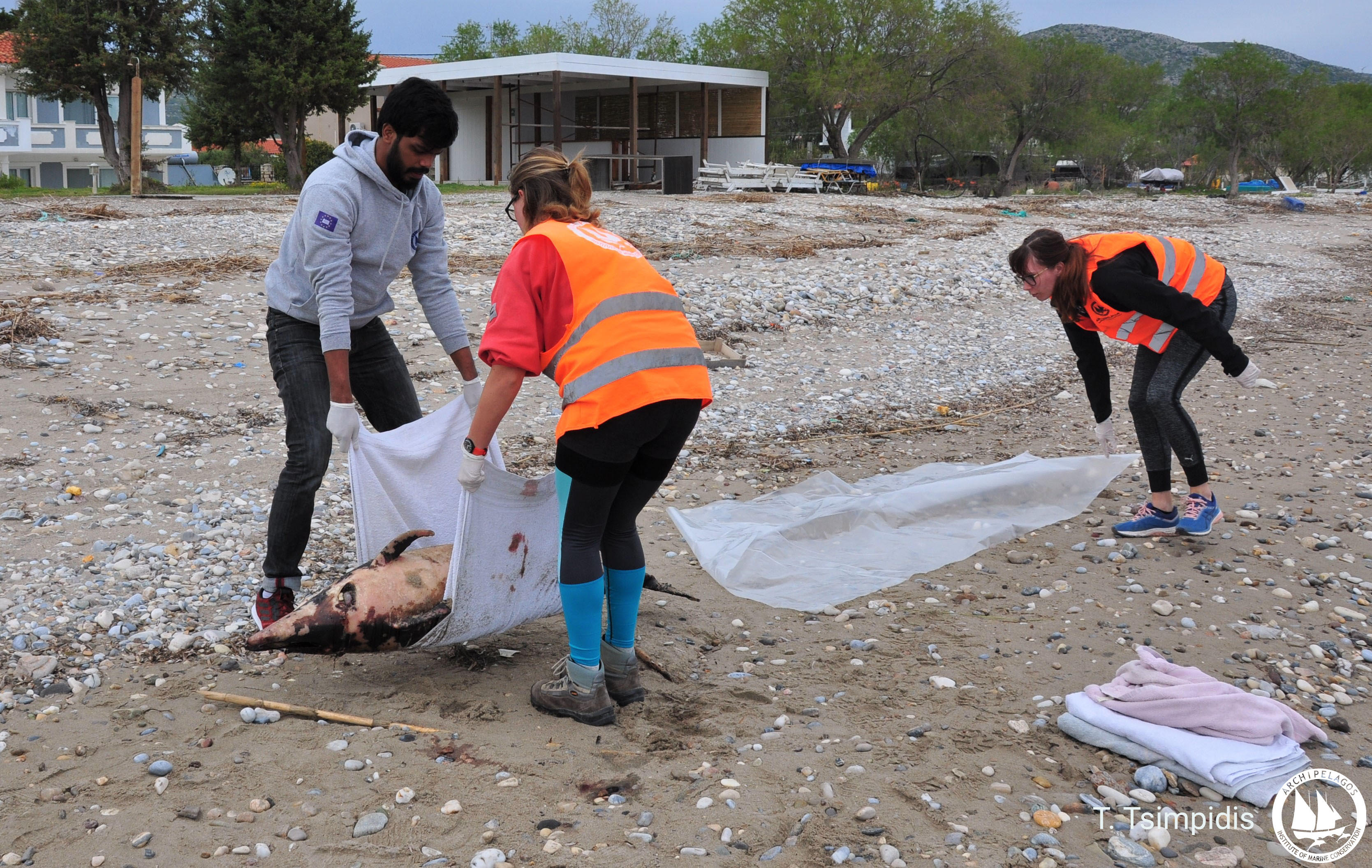
After the 15 dead dolphins of previous weeks, another one was found last Saturday that was in a
state of advanced decomposition and is estimated to have been dead in the sea for many days. The
problem of rare marine animals that end up dead on our coasts as a result of various anthropogenic
causes is not something new. The incidents of recent weeks are just the culmination. As
mentioned in the previous announcement, the effective protection of the Aegean as an ecosystem
must be an important part of the Greek-Turkish dialogue. This should be achieved by avoiding
nationalistic approaches and instead cooperating through good neighbourly relations, with the
aim of finding and implementing solutions to existing common problems.

All of us at the Archipelagos Institute, but also all others working for the protection of our seas, cannot
accept the role of becoming the undertaker for rare species or just present to count the losses.

It is time for both the state and the citizens to stand and acknowledge the real size of the
numerous, growing threats to our marine ecosystems and species that depend upon them.
Otherwise, we will be consigned to history as the generations that accepted impending
disaster on our watch.

Thodoris Tsimpidis
Director
Institute for Marine Protection Archipelagos
0
0
0
0
0

What you can read next

Tragedy in Turkey and Syria
Work Group Meeting with Representatives of Barcelona Municipality
Naftilos embarks on the Accobams Survey Initiative

HIGHLIGHTS

  • International Visitors at the Aegean Marine Life Sanctuary Project

    International Visitors at the Aegean Marine Life Sanctuary Project

    1 June 2021
    At Archipelagos Institute of Marine Conservation an important visit took …
  • The Efkranti Award was Granted to the Archipelagos Institute of Marine Conservation

    The Efkranti Award was Granted to the Archipelagos Institute of Marine Conservation

    27 July 2020
    It was a great honor but also great moral support …
  • The President of the Hellenic Republic’s visit to Archipelagos research vessel, the Aegean Explorer

    The President of the Hellenic Republic’s visit to Archipelagos research vessel, the Aegean Explorer

    30 June 2020
    Yesterday, during the President of the Republic’s visit to the …
  • Award to Archipelagos: Best Heroic Act of Environmental Stewardship

    Award to Archipelagos: Best Heroic Act of Environmental Stewardship

    19 February 2020
    The Short Documentary Film presenting the Aegean Marine Life Sanctuary, …
  • Award to Archipelagos Institute from the International Propeller Club of the United States

    Award to Archipelagos Institute from the International Propeller Club of the United States

    6 February 2020
    We would like to thank the International Propeller Club of …

Recent Posts

  • Photo-ID & Behavioral Assessments of Delphinus delphis in the Northern Aegean Sea

    Photo-ID & Behavioral Assessments of Delphinus delphis in the Northern Aegean Sea

    2 November 2023
    Yasas! Intern Alannah from the Marine Mammal Field here, currently …
  • Experiences After Work at Archipelagos

    Experiences After Work at Archipelagos

    2 November 2023
    Hi, I’m Ella and I completed a 6-week internship on …
  • Hands-on Projects with the Marine Mammal Research & Conservation Team

    Hands-on Projects with the Marine Mammal Research & Conservation Team

    2 November 2023
    My name is Sjoerd and I am in the last …
  • Planting Underwater Gardens of Posidonia seagrass- a new innovative planting process

    Planting Underwater Gardens of Posidonia seagrass- a new innovative planting process

    29 June 2023
    An innovative process of planting underwater gardens of Posidonia oceanica …
  • A special three-day research expedition to the Ikaria Trench

    A special three-day research expedition to the Ikaria Trench

    19 May 2023
    Archipelagos Marine Mammal Research team took part in a very …
  • Aegean Islet Conservation Project in cooperation with the University of Toronto’s Faculty of Architecture

    Aegean Islet Conservation Project in cooperation with the University of Toronto’s Faculty of Architecture

    17 May 2023
    A new cycle of interdisciplinary on-site research of the Aegean …
  • Mutilated Striped Dolphin Stranded on the shores of Samos Island

    Mutilated Striped Dolphin Stranded on the shores of Samos Island

    12 May 2023
    A mutilated striped dolphin was found stranded on the north …

Subscribe to Our Newsletter

Archipelagos Institute of Marine Conservation is committed to researching and defending the biodiversity of the Greek seas and islands.

Our action is possible only with your help!

donate
  • Contact us
  • Placements

Archipelagos - Institute of Marine Conservation © All Rights Reserved || Developed Fekas Brothers

TOP