Archipelagos

  • English
  • Ελληνικα
Who We Are
The TeamThe Team
Research BasesResearch Bases
Research BoatsResearch Boats
Our EquipmentOur Equipment
PartnersPartners
SupportersSupporters
Fields of Action
Marine ConservationMarine Conservation Fisheries Shipping Risks Seagrass Meadows Coralligene Conservation Littoral Ecosystems Invasive Species Jellyfish Sea Turtles
Marine MammalsMarine Mammals Dolphins and Porpoises Whales Seals
Terrestrial ConservationTerrestrial Conservation Island Fauna Forests & Flora Freshwater Ecosystems Aegean Seed Bank
Laboratory ResearchLaboratory Research Microplastics Water Analysis Soil Quality
Projects
Aegean Marine Life Sanctuary
Eco-Navigation
FIsh4Life
Save the Aegean
Join Us
Internships in the Aegean
Remote Internships
Interns Experiences
Field Courses
News
Planting Underwater Gardens of Posidonia seagrass- a new innovative planting process
Aegean Islet Conservation Project in cooperation with the University of Toronto’s Faculty of Architecture
Mutilated Striped Dolphin Stranded on the shores of Samos Island
Posidonia Seagrass Fruits Wash up on Our Shores – A Rare Phenomenon
View All...
Contact us
Publications
Videos
Awareness Material
Donate
Menu

Worrying Rise of the Number of Dead Marine Turtles Found in the Aegean

Worrying Rise of the Number of Dead Marine Turtles Found in the Aegean

by Kleopatra Delaveri / Thursday, 31 May 2018 / Published in Marine Conservation, News, Press Releases

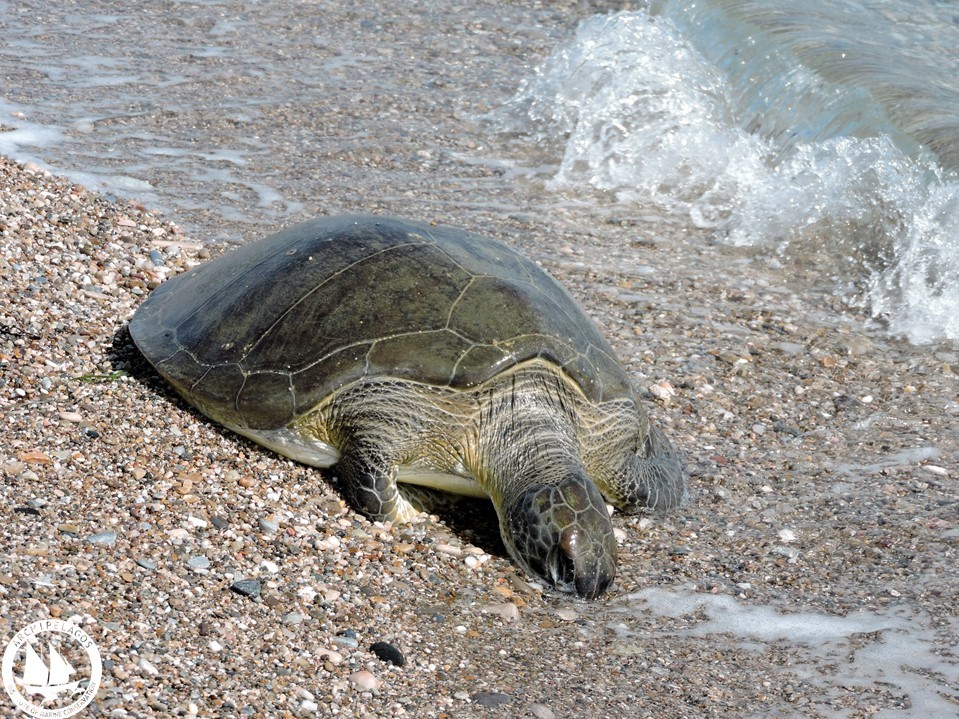
A worrying rise in the number of marine turtles found dead on the shores of the eastern Aegean was recorded by researchers at the Archipelagos Institute of Marine Conservation. In just 3 months from the beginning of 2018, researchers identified 18 stranded sea turtles, 16 of which were dead and only 2 alive but in particularly poor condition. These incidents were recorded on the shores of the eastern Aegean Sea within a radius of just 10 nautical miles of a marine region that is being monitored daily by the Institute’s researchers. Numerous other sea turtle strandings have been reported during the same time period in many other regions of Greece. However, we need to  the existing knowledge gap, in relation to the actual total number of dead turtles that have died, as the Greek coastline 18,000 km in length and the majority of the incidents occur on inaccessible or remote shores, and hence are rarely noticed or reported out of the touristic season.
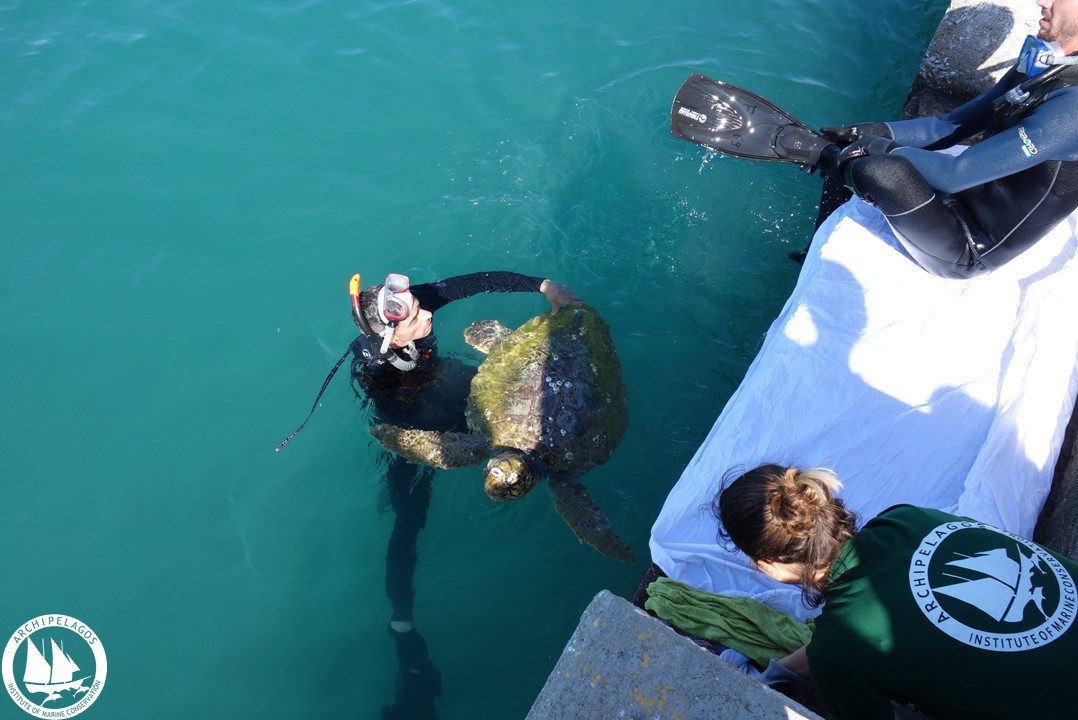
One of the sea turtles found alive was entangled in a plastic sack in which its neck and one of its front flippers was trapped while pieces of plastic from the sack had penetrated into its mouth and throat. This particular turtle was very lucky as a fisherman found it in time and after a few days of care with the veterinarian of Archipelagos Institute, it was again able to be released into the sea.
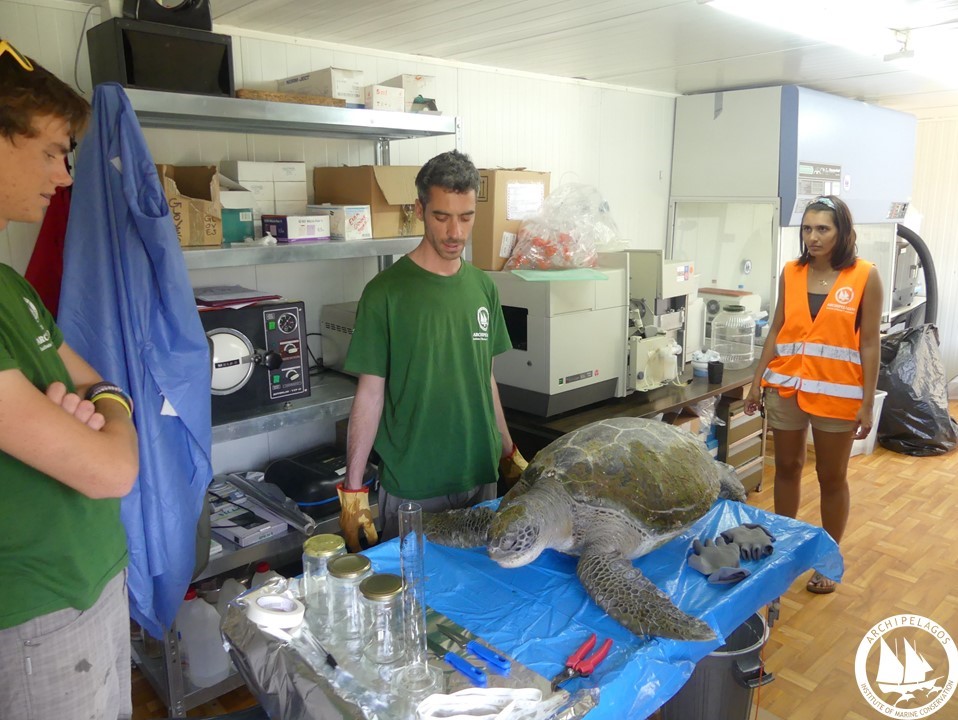
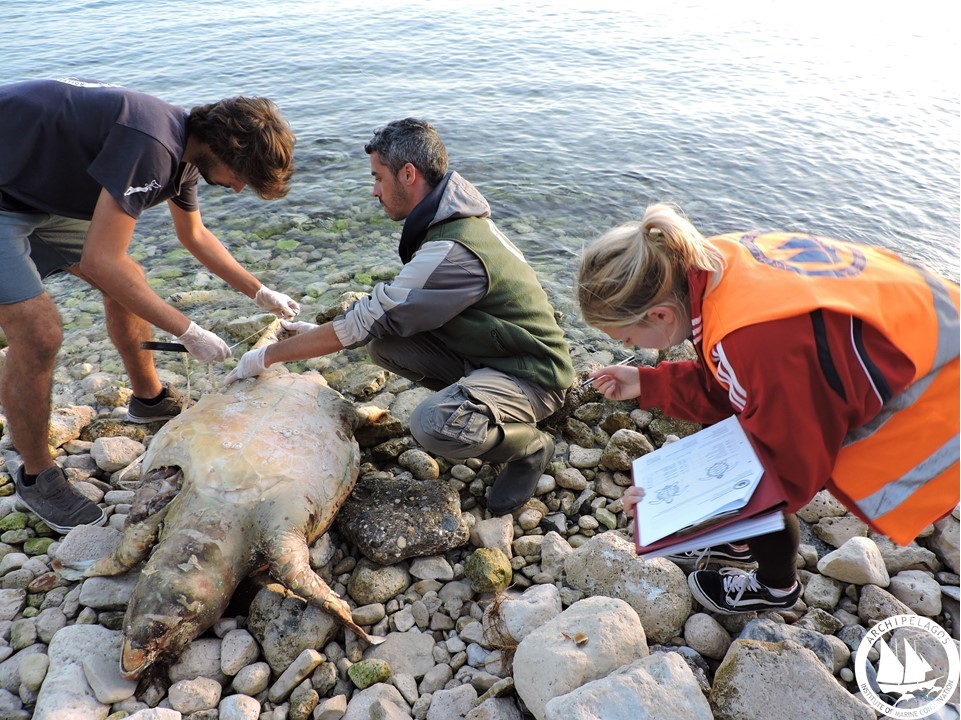
According to the results of the necropsies carried out for each animal, almost all of the incidents showed signs of human impact (signs of previous boat collisions, pieces of plastic and fishing gear in the stomach and the gastrointestinal system, etc.). However, while the direct anthropogenic effect did not cause the death of many of these sea turtles, it is certain that plastic pollution has an important and increasing role in the killing of these charismatic animals which have survived thousands of years in our seas.
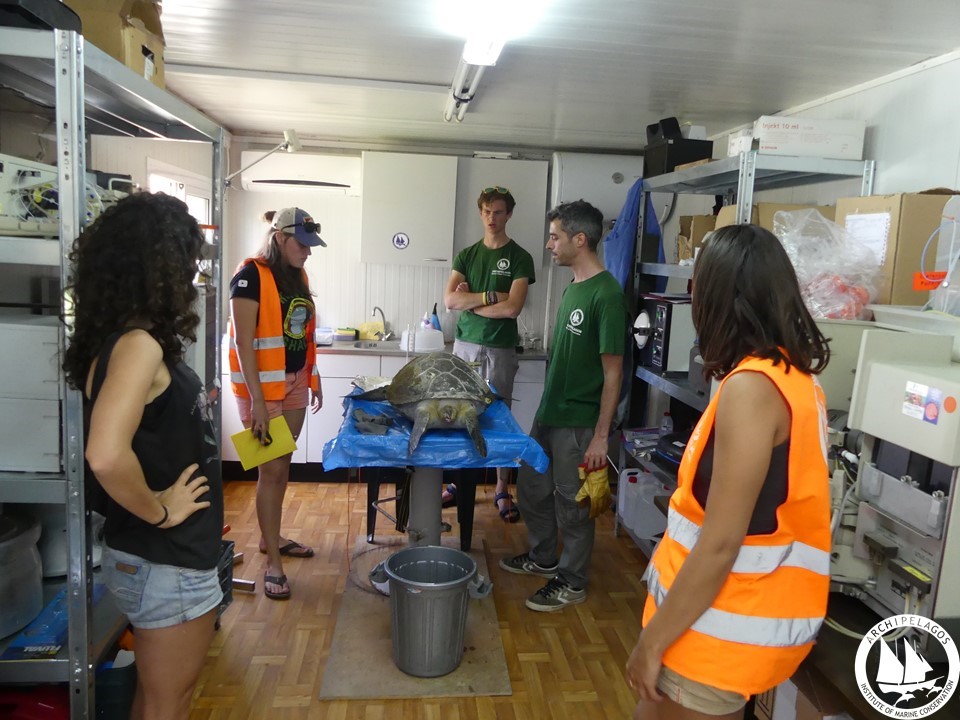
It is noteworthy that out of the 18 stranding incidents, 8 were Loggerhead Turtles (Caretta caretta) and 8 were Green Turtles (Chelonia mydas), a species that usually prefers warmer waters. For both species the turtles were of different ages, sizes and sexes. The populations of these 2 species of sea turtle are declining at an alarming rate in many other parts of the Mediterranean, while Greek seas still support significant ecosystems providing key foraging and breeding grounds for these species.

Dr. Guido Pietroluongo, the veterinarian of Archipelagos Institute, says: “These unusual incidents of mass mortality on the shores of the Eastern Aegean seem to be a cry for help by the marine biodiversity.”
Click here to see the VIDEO

0
0
0
0
0

What you can read next

The Aegean Explorer travels to the small islands of the Cyclades
Sea4All Online Educational Platform on Marine Pollution
Meeting with Maria Damanaki, Commissioner for Maritime Affairs and Fisheries

HIGHLIGHTS

  • International Visitors at the Aegean Marine Life Sanctuary Project

    International Visitors at the Aegean Marine Life Sanctuary Project

    1 June 2021
    At Archipelagos Institute of Marine Conservation an important visit took …
  • The Efkranti Award was Granted to the Archipelagos Institute of Marine Conservation

    The Efkranti Award was Granted to the Archipelagos Institute of Marine Conservation

    27 July 2020
    It was a great honor but also great moral support …
  • The President of the Hellenic Republic’s visit to Archipelagos research vessel, the Aegean Explorer

    The President of the Hellenic Republic’s visit to Archipelagos research vessel, the Aegean Explorer

    30 June 2020
    Yesterday, during the President of the Republic’s visit to the …
  • Award to Archipelagos: Best Heroic Act of Environmental Stewardship

    Award to Archipelagos: Best Heroic Act of Environmental Stewardship

    19 February 2020
    The Short Documentary Film presenting the Aegean Marine Life Sanctuary, …
  • Award to Archipelagos Institute from the International Propeller Club of the United States

    Award to Archipelagos Institute from the International Propeller Club of the United States

    6 February 2020
    We would like to thank the International Propeller Club of …

Recent Posts

  • Photo-ID & Behavioral Assessments of Delphinus delphis in the Northern Aegean Sea

    Photo-ID & Behavioral Assessments of Delphinus delphis in the Northern Aegean Sea

    2 November 2023
    Yasas! Intern Alannah from the Marine Mammal Field here, currently …
  • Experiences After Work at Archipelagos

    Experiences After Work at Archipelagos

    2 November 2023
    Hi, I’m Ella and I completed a 6-week internship on …
  • Hands-on Projects with the Marine Mammal Research & Conservation Team

    Hands-on Projects with the Marine Mammal Research & Conservation Team

    2 November 2023
    My name is Sjoerd and I am in the last …
  • Planting Underwater Gardens of Posidonia seagrass- a new innovative planting process

    Planting Underwater Gardens of Posidonia seagrass- a new innovative planting process

    29 June 2023
    An innovative process of planting underwater gardens of Posidonia oceanica …
  • A special three-day research expedition to the Ikaria Trench

    A special three-day research expedition to the Ikaria Trench

    19 May 2023
    Archipelagos Marine Mammal Research team took part in a very …
  • Aegean Islet Conservation Project in cooperation with the University of Toronto’s Faculty of Architecture

    Aegean Islet Conservation Project in cooperation with the University of Toronto’s Faculty of Architecture

    17 May 2023
    A new cycle of interdisciplinary on-site research of the Aegean …
  • Mutilated Striped Dolphin Stranded on the shores of Samos Island

    Mutilated Striped Dolphin Stranded on the shores of Samos Island

    12 May 2023
    A mutilated striped dolphin was found stranded on the north …

Subscribe to Our Newsletter

Archipelagos Institute of Marine Conservation is committed to researching and defending the biodiversity of the Greek seas and islands.

Our action is possible only with your help!

donate
  • Contact us
  • Placements

Archipelagos - Institute of Marine Conservation © All Rights Reserved || Developed Fekas Brothers

TOP